
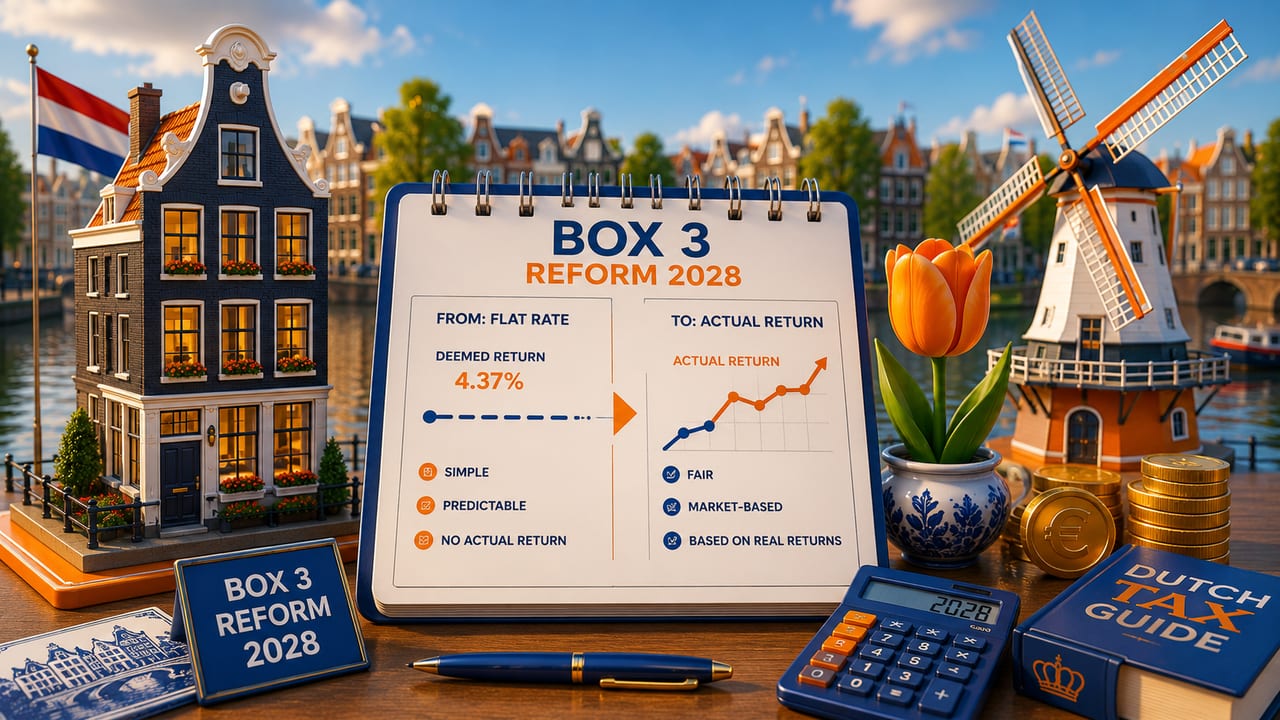
The Transition from Deemed to Actual Returns in Box 3
The Dutch wealth tax system (Box 3) has been in a state of flux since a landmark 2021 Supreme Court ruling (commonly known as the Kerstarrest) declared the fictitious-return taxation method unconstitutional. This ruling forced the government to design a temporary transitional system and work toward a permanent solution.
On 12 February 2026, the Dutch House of Representatives passed the Wet werkelijk rendement box 3 (Actual Return in Box 3 Act). Designed to take effect on 1 January 2028, this bill shifts the tax base from arbitrary deemed returns (which assumed a 6.00% yield on investments in 2026 regardless of performance) to actual return taxation at a proposed flat rate of 36%.
While the transition makes the system fairer during down years, it introduces a highly controversial mechanism: the annual taxation of unrealized (paper) investment gains. Savers and investors will no longer pay tax on a simulated average return; instead, they will face a tax bill based on the net appreciation of their portfolios, whether or not they sell their holdings to lock in those gains.
Important
To model your tax liability under the current system versus the proposed rules, use our interactive Box 3 Wealth Tax Calculator.
1. How the Proposed 2028 Box 3 Rules Work
The new system splits assets into two different taxation methods depending on their liquidity, ensuring that illiquid investments are not subject to cash flow crises from taxing paper gains:
A. Vermogensaanwasbelasting (Wealth Growth Tax)
For liquid assets such as publicly traded stocks, bonds, savings accounts, and cryptocurrencies, you are taxed on the net growth of your wealth during the calendar year.
- This includes all realized returns (interest, dividends).
- It also includes unrealized capital gains (the increase in the market value of your portfolio from January 1 to December 31, even if you did not sell a single asset).
- Example: If you start the year with €50,000 in shares and end the year with €60,000 in shares without selling, you are taxed on the €10,000 paper gain.
B. Vermogenswinstbelasting (Capital Gains Tax)
For illiquid assets such as real estate (non-primary residence) and shares in startups/scale-ups, tax is only applied when the gains are realized (upon sale of the asset).
- Expenses incurred (such as property maintenance or startup investment fees) are deductible from the taxable gain.
- This prevents property owners or startup founders from having to sell assets or borrow money just to pay wealth taxes on paper growth.
2. The Tax-Free Result (Heffingsvrij Resultaat)
In 2026, the Box 3 system exempts the first €59,357 of wealth from taxation (€118,714 for fiscal partners).
Under the proposed 2028 system, the wealth-based allowance is eliminated. Savers and investors will no longer get a tax-free capital exemption. Instead, they get a tax-free result threshold of €1,800 (€3,600 for fiscal partners) on their earnings.
- This means you pay 36% tax only on Box 3 returns (realized and unrealized combined) that exceed €1,800 per year.
- For example, if your total actual savings interest and investment gains sum to €5,000, your taxable return is €3,200 (€5,000 - €1,800), resulting in €1,152 in Box 3 tax. This represents a significant shift that penalizes successful investment strategies while providing relief to small savers holding low-yield accounts.
3. Comparing the Systems: A Real-World Scenario
Let's look at Anouk, who holds €100,000 in stocks. In a given year, her portfolio grows by 8.0% (a €8,000 actual gain), and she receives €2,000 in dividends, totaling €10,000 in actual returns. Anouk files as a single person.
Scenario A: 2026 Transitional System
- Wealth: €100,000
- Allowance: €59,357
- Taxable Wealth: €40,643
- Deemed Yield on investments (6.00%): €100,000 × 6.00% = €6,000 deemed return.
- Calculated Income: €6,000 × (€40,643 / €100,000) = €2,438.58.
- Box 3 Tax (36%) = €2,438.58 × 0.36 = €877.89
Scenario B: 2028 Proposed System (Actual Return)
- Actual Returns (dividend + growth): €10,000
- Tax-Free Result: €1,800
- Taxable Return: €8,200
- Box 3 Tax (36%) = €8,200 × 0.36 = €2,952.00
Analysis: In a strong growth year, Anouk pays €2,074 more tax under the proposed actual return system because her actual yield (10.0%) exceeds the 6.00% deemed rate, and her entire paper gain is taxed immediately. However, if the stock market fell and her portfolio lost €10,000, she would pay €0 tax in both 2026 and 2028. Under the 2026 transitional rules, she can invoke the rebuttal scheme (tegenbewijsregeling / Actual Return Statement) introduced after the 2021 Supreme Court ruling to be taxed only on her actual return (€-10,000), resulting in €0 tax. In 2028, she would also pay €0 and carry forward the loss indefinitely to offset future gains. This highlights how the current rebuttal scheme already provides loss protection, though the 2028 system makes it automatic.
Tax Planning Strategies for Dutch Investors
To navigate the transition to the 2028 actual return system, investors should evaluate several structural options:
- Loss Harvesting: If you hold liquid assets with unrealized losses, it may be beneficial to hold them to offset future gains. The proposed framework allows carrying forward net Box 3 losses to future tax years indefinitely (with no time limit) to offset future investment gains, provided losses exceed the €500 administrative threshold.
- Open VBI or BV Structure: For high-net-worth investors, placing liquid portfolios inside a private limited company (BV) or a dedicated open fund for joint account (FGR) may shield investments from Box 3, moving them to Corporate Income Tax (VPB) where capital gains are only taxed upon realization.
- Savings vs. Investments: Since savings yields are lower than equity yields, small savers will likely pay zero tax under the €1,800 result threshold, making basic savings accounts highly tax-efficient compared to previous years.
Tip
To see a year-by-year curve comparison of your wealth tax burden under both regimes, consult our Box 3 2026 vs Box 3 2028 Comparison.