
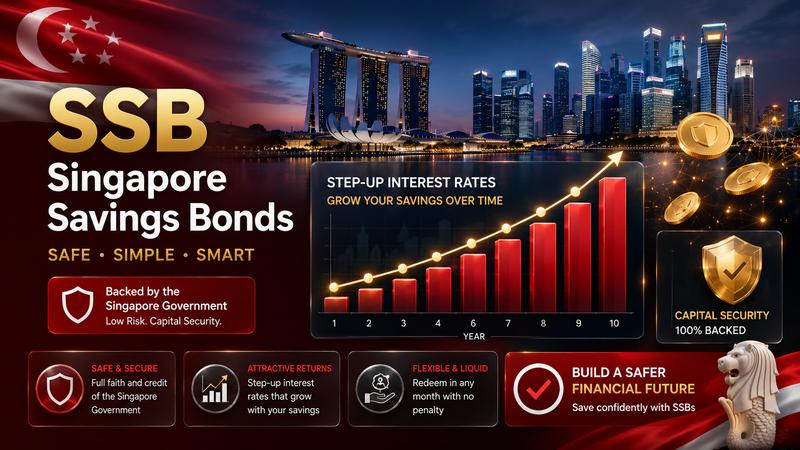
Executive Summary: Why SBAUG26 Matters Today
In the current macroeconomic environment of mid-2026, central banks globally are navigating a delicate path of interest rate adjustments. For retail savers in Singapore, this has led to a shifting yield landscape. The August 2026 Singapore Savings Bond (SSB) issue, coded as GX26080T (referred to as SBAUG26), offers a critical opportunity.
With a 10-year simple average yield of 2.08% per annum (corresponding to an average annual compounded return of 2.06% p.a.) and a first-year step-up interest rate starting at 1.46% p.a., this tranche represents a vital defensive asset class. SSBs are fully capital-guaranteed by the Singapore Government, offering retail investors an institutionally secure place to park cash while retaining monthly liquidity.
This guide provides the ultimate, comprehensive breakdown of the SBAUG26 tranche, step-up interest mechanics, holding scenarios, comparison grids, and application procedures.
1. What are Singapore Savings Bonds (SSB)?
Singapore Savings Bonds (SSBs) are special retail bonds issued by the Government of Singapore through the Monetary Authority of Singapore (MAS). Introduced in October 2015, the program aims to provide retail savers with a safe, flexible, and long-term investment option.
The AAA Sovereign Credit Guarantee
SSBs are unique because they are backed by the full credit of the Singapore Government. Singapore is one of the very few countries in the world to hold the highest AAA credit rating from all major international rating agencies (S&P, Moody's, and Fitch). This means that both your principal investment and all scheduled interest payments are completely risk-free, with zero probability of default.
Key Characteristics of SSBs
- Accessibility: You can invest with a minimum of S$500. This low barrier makes it accessible to beginners and seasoned investors alike.
- Maximum Ceiling: There is an individual holding limit of S$200,000 across all active issues.
- Maturity: Each SSB has a maximum term of 10 years, at which point the bond matures and your principal is automatically returned.
- Liquidity: Unlike standard government securities or commercial bonds, SSBs can be redeemed early in any given month prior to maturity.
- No Capital Losses: Regardless of market fluctuations, you will always get your full principal back. You are protected from the capital losses that usually affect bond portfolios when interest rates rise.
2. Understanding the Step-Up Coupon Structure
The hallmark of the SSB program is the step-up coupon rate. When you subscribe to an issue, you lock in a pre-determined schedule of interest rates that increase each year you hold the bond.
Why do the rates step up?
MAS structures the coupons so that the yield matches the return of Singapore Government Securities (SGS) of equivalent tenors. Since longer-term government bonds typically pay higher yields than short-term ones, the interest rate on your SSB steps up annually to reward you for holding the bond longer.
For the SBAUG26 tranche, the year-by-year interest rate schedule is:
| Year | Coupon Rate (Interest Rate p.a.) |
|---|---|
| Year 1 | 1.46% p.a. |
| Year 2 | 1.75% p.a. |
| Year 3 | 1.80% p.a. |
| Year 4 | 1.80% p.a. |
| Year 5 | 1.90% p.a. |
| Year 6 | 2.11% p.a. |
| Year 7 | 2.27% p.a. |
| Year 8 | 2.43% p.a. |
| Year 9 | 2.58% p.a. |
| Year 10 | 2.72% p.a. |
How Payouts Work
Interest is calculated as simple interest on your principal and is paid out semi-annually (every 6 months) directly into your linked bank account. Payments occur on the 1st of February and the 1st of August each year until maturity or early redemption.
3. The Math of Yields: Simple Average vs. Compounded Yield
There is often confusion between the "Simple Average Yield" and the "Compounded Annual Return" published by MAS. It is critical to understand the distinction:
Simple Average Yield
This is the simple mathematical average of the coupon rates over your holding period. For example, if you hold the bond for 10 years:
Simple Average = (1.46 + 1.75 + 1.80 + 1.80 + 1.90 + 2.11 + 2.27 + 2.43 + 2.58 + 2.72) / 10 = 2.082% p.a.
On a S$10,000 investment, this simple average means you receive exactly S$2,082 in total cash interest over the 10-year period.
Compounded Annual Yield (YTM)
MAS lists the 10-year average compounded return for SBAUG26 as 2.06% p.a.
This is the Yield to Maturity (YTM) calculated using the time-value-of-money formula. Because interest is distributed semi-annually rather than being accumulated and compounded inside the bond, the compounded yield is slightly lower than the simple average coupon rate. The 2.06% figure reflects the rate at which your principal would have to grow under annual compounding to yield the same final sum if you did not touch the payouts.
4. Year-by-Year Cash Payout Breakdown
To help you visualize exactly how much cash you will receive, here is a detailed breakdown of the semi-annual payments for a S$10,000 investment in SBAUG26:
| Year | Coupon Rate | Total Annual Interest | Semi-Annual Payout 1 (Feb) | Semi-Annual Payout 2 (Aug) |
|---|---|---|---|---|
| Year 1 | 1.46% p.a. | S$146.00 | S$73.00 | S$73.00 |
| Year 2 | 1.75% p.a. | S$175.00 | S$87.50 | S$87.50 |
| Year 3 | 1.80% p.a. | S$180.00 | S$90.00 | S$90.00 |
| Year 4 | 1.80% p.a. | S$180.00 | S$90.00 | S$90.00 |
| Year 5 | 1.90% p.a. | S$190.00 | S$95.00 | S$95.00 |
| Year 6 | 2.11% p.a. | S$211.00 | S$105.50 | S$105.50 |
| Year 7 | 2.27% p.a. | S$227.00 | S$113.50 | S$113.50 |
| Year 8 | 2.43% p.a. | S$243.00 | S$121.50 | S$121.50 |
| Year 9 | 2.58% p.a. | S$258.00 | S$129.00 | S$129.00 |
| Year 10 | 2.72% p.a. | S$272.00 | S$136.00 | S$136.00 |
| Total | 2.08% average | S$2,082.00 | - | - |
At the end of Year 10, you will have received a total of S$2,082 in cash interest payments. The principal of S$10,000 is returned to you in full, resulting in a total wealth value of S$12,082.
5. Case Study Scenarios: Modeling holding tenors
Depending on when you choose to redeem your bonds, your returns will vary. Let us look at three common investor profiles:
Case Study 1: Cheryl (The Short-Term Emergency Fund saver)
- Investment: S$10,000
- Holding Period: 2 Years
- Strategy: Cheryl uses SSBs as a high-yield emergency buffer. She decides to redeem her bonds after 2 years to purchase a home.
- Coupons Received: S$146 (Year 1) + S$175 (Year 2) = S$321 total interest.
- Simple Average Yield: 1.61% p.a. Cheryl receives her S$10,000 back in full with zero capital loss.
Case Study 2: Keith (The Medium-Term Goal Planner)
- Investment: S$50,000
- Holding Period: 5 Years
- Strategy: Keith is saving for a wedding and car downpayment. He holds his bonds for 5 years.
- Coupons Received: (1.46% + 1.75% + 1.80% + 1.80% + 1.90%) x S$50,000 = S$4,355 total interest.
- Simple Average Yield: 1.74% p.a. Keith has accumulated S$4,355 in cash distributions while maintaining the option to exit early.
Case Study 3: Rachel (The Long-Term Retirement Planner)
- Investment: S$150,000
- Holding Period: 10 Years (Maturity)
- Strategy: Rachel holds the bond to full maturity to complement her CPF retirement nest egg.
- Coupons Received: S$150,000 x 20.82% total interest rate = S$31,230 total interest.
- Simple Average Yield: 2.08% p.a. Rachel's initial capital is returned in full, totaling S$181,230.
6. Singapore Cash-Parking Comparison: SSB vs. T-Bills vs. Fixed Deposits
Savers in Singapore have multiple safe-haven options. Understanding how SSBs compare to T-bills and bank fixed deposits is key to maximizing returns:
1. Singapore Treasury Bills (T-Bills)
- Tenor: 6 Months or 1 Year.
- Yield: Recently cut-off yields are around 1.50% p.a.
- Pros: Slightly higher yields than the initial Year 1 SSB rate.
- Cons: Zero liquidity before maturity (cannot be redeemed early; must be sold on secondary market through a broker with price risk). You face reinvestment risk at the end of 6 months.
2. Commercial Bank Fixed Deposits
- Tenor: 6, 9, or 12 Months.
- Yield: Promotional rates currently range between 1.45% and 1.60% p.a.
- Pros: Good short-term yield security.
- Cons: High minimum placement requirements (often S$10,000 to S$25,000). Early withdrawal penalty applies (you forfeit most or all interest earned).
3. Singapore Savings Bonds (SSBs)
- Tenor: Up to 10 Years.
- Yield: 1.46% (Year 1) to 2.72% (Year 10).
- Pros: Long-term rate lock-in (up to 10 years) protecting you from falling interest rates. Extreme liquidity with monthly early redemptions and zero penalty.
- Cons: The yield in the first year is slightly lower than a T-bill or promotional fixed deposit.
7. Strategic Synergy: SSB and CPF/SRS Tax Planning
SSBs can be used as a powerful tool in broader retirement and tax planning in Singapore:
SSB vs. CPF Ordinary Account (OA)
The CPF Ordinary Account currently pays a guaranteed base interest rate of 2.50% p.a.
- If you are looking for short-term liquidity, SSBs are better because CPF OA withdrawals are restricted to housing, education, and investment schemes.
- However, for pure long-term retirement growth under S$200,000, leaving funds in CPF OA is mathematically superior to holding the SBAUG26 tranche, which averages 2.06% compounded.
SSB with Supplementary Retirement Scheme (SRS)
You can purchase SSBs using your SRS funds. SRS is a voluntary scheme to encourage savings for retirement, offering tax deductions on your contributions.
- Idle cash in SRS accounts earns a measly 0.05% p.a.
- Investing your SRS cash in SSBs immediately bumps your return to a safe, step-up yield profile, making it a perfect low-risk option to keep SRS funds productive.
8. Step-by-Step Application Guide
If you wish to subscribe to the SBAUG26 issue, follow this step-by-step process:
Prerequisites
- Age: You must be at least 18 years old.
- Bank Account: You need an active bank account with DBS/POSB, OCBC, or UOB.
- CDP Account: You need an individual Central Depository (CDP) securities account. Joint CDP accounts are not eligible.
- DCS Link: Your bank account must be linked to your CDP account via Direct Crediting Service (DCS) so that interest payouts and redemption proceeds are credited directly to your bank account.
How to Apply via Internet Banking
- Log in to your bank's desktop portal (DBS, OCBC, or UOB).
- Navigate to the Invest or Securities section.
- Select Singapore Government Securities (SGS) or Singapore Savings Bonds (SSB).
- Choose the current tranche (SBAUG26 or Issue Code GX26080T).
- Input your 12-digit CDP Securities Account Number.
- Specify the investment amount (must be in multiples of S$500, starting from S$500).
- Confirm the subscription. A non-refundable S$2 transaction fee is debited.
How to Apply via ATM
- Insert your debit card at a local DBS/POSB, OCBC, or UOB ATM.
- Select More Services or Investment Services.
- Choose Singapore Government Securities -> Singapore Savings Bonds.
- Verify your CDP account details.
- Input the subscription amount and submit. The S$2 transaction fee applies.
9. Early Redemption: How to Get Your Cash Back
If you need to retrieve your capital before the 10-year maturity, the redemption process is fast and incurs no interest penalties:
Key Rules
- Monthly Cycles: Redemptions are processed once a month. You must submit your request during the monthly application window (which opens on the 1st business day at 6:00 pm and closes on the 4th last business day of the month at 9:00 pm).
- Payment Timelines: The principal plus any accrued interest will be credited to your linked bank account on the second business day of the following month.
- Redemption Fee: A flat S$2 transaction fee applies for each redemption request.
Step-by-Step Redemption
- Log in to your bank's mobile app or internet banking portal.
- Go to the investment or government securities section.
- Select Redeem Singapore Savings Bonds.
- Choose the specific bond tranche you hold.
- Specify the redemption amount (in multiples of S$500).
- Submit the request. The S$2 fee will be deducted, and your cash will land in your account at the start of the next month.
10. Risk Assessment and Portfolio Allocation Strategy
While Singapore Savings Bonds are theoretically risk-free, smart capital allocation requires evaluating opportunity costs and structural limitations:
- Opportunity Cost of Capped Yields: Because your rate schedule is locked at issuance, if inflation spikes and global interest rates rise significantly, you are locked into the 2.08% simple average rate. However, you can mitigate this by redeeming early and switching to a newer tranche.
- Portfolio Placement: SSBs are best positioned as a secondary cash reserve tier. Your primary tier should be highly liquid high-yield savings accounts (like UOB One or OCBC 360) for immediate transaction bills. Your tertiary tier should consist of diversified equity index funds for long-term compounding.
- CDP Safeguards: Keep in mind that individual CDP accounts belong exclusively to you. In estate planning, SSBs are treated as personal assets and will go through standard probate, so plan accordingly.
By layering your liquidity tiers across high-yield savings, SSBs, and index funds, you maintain maximum financial resilience under any market condition.