
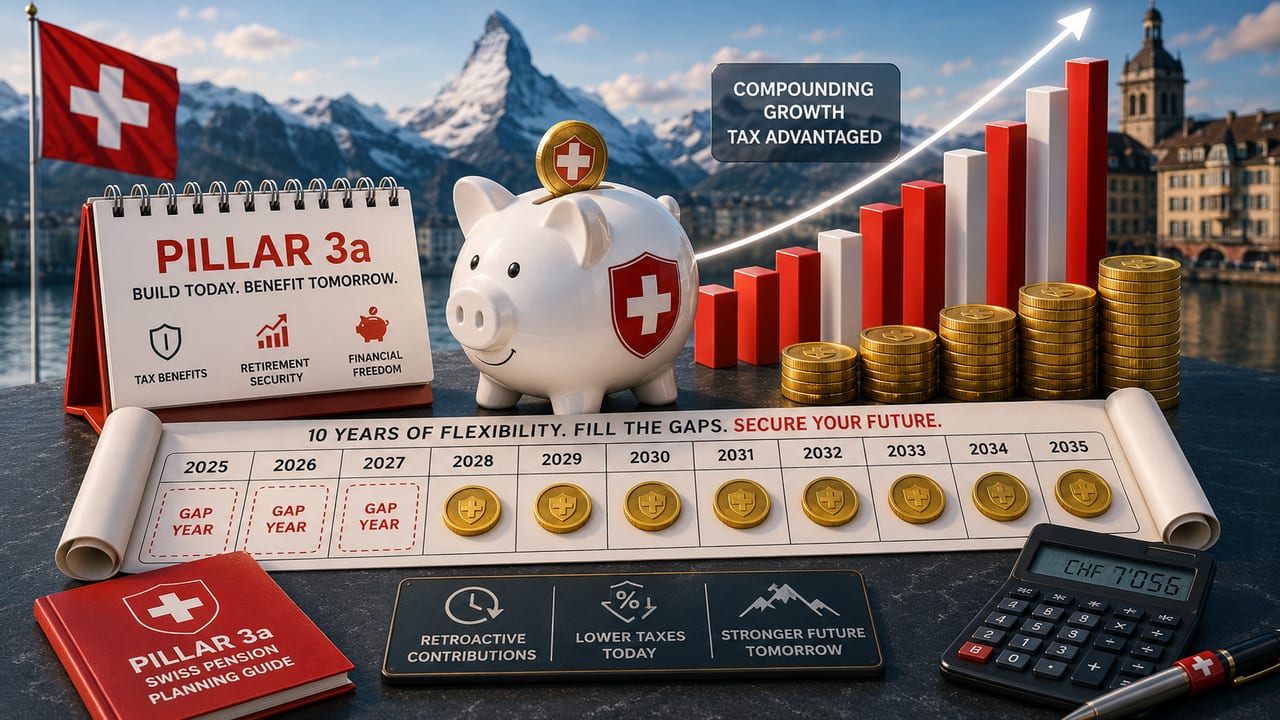
Navigating Switzerland's New Pillar 3a Catch-Up Rule in 2026
Starting in the 2026 tax year, Switzerland has introduced a landmark pension reform that allows individuals to make retroactive top-up contributions into their Pillar 3a accounts. This new regulation represents a major opportunity to close historical retirement savings gaps and claim substantial tax deductions. By allowing citizens to retrospectively contribute to their private pension accounts, the Swiss Federal Council aims to support flexible career paths, parental leaves, and relocation periods where savings may have been deferred.
However, the law is governed by strict eligibility rules and caps designed to regulate tax savings. Taxpayers cannot simply buy back unlimited years of missed contributions; instead, they must plan their catch-up payments methodically within the rolling ten-year window established by the legislation.
The Core Rule: Gaps Post-2025 Only
While the legislation permits closing gaps from up to ten years ago, there is a critical start date limitation that prevents retroactivity prior to the launch of the reform:
Important
You can only make retroactive buy-ins for contribution gaps that arose from January 1, 2025, onwards. Any gaps in your Pillar 3a history prior to 2025 cannot be filled and are permanently lost.
Eligibility Requirements: How to Qualify for a Buy-In
To perform a retroactive Pillar 3a buy-in, you must meet all the following legal conditions:
- Max Out the Current Year First: You are only allowed to make a catch-up payment if you have already contributed the full ordinary annual maximum to your Pillar 3a for the current calendar year (CHF 7,258 for salaried employees in 2026). This ensures that retroactive buybacks are used on top of, rather than as a substitute for, active retirement savings.
- AHV-Liable Income: You must have had earned income subject to Swiss OASI (AHV) contributions both in the year the contribution gap arose and in the year you make the buyback payment. This means individuals who were completely out of the Swiss workforce without taxable income (such as non-working spouses without a separate income) are ineligible to buy back those years.
- One-Time Deposit per Year: Each specific gap year must be closed with a single, one-time payment. You cannot pay off a single year's gap in multiple small installments, which requires savers to accumulate the necessary liquidity before initiating the buy-in.
- No Prior Payouts: You must not have reached retirement age or withdrawn your Pillar 3a savings for other purposes (such as home ownership or leaving Switzerland permanently).
The Annual Buy-In Limit
You cannot fill all your historical gaps at once. The Swiss federal government has capped the maximum catch-up contribution you can make in any single calendar year to prevent massive, single-year tax deductions that would impact municipal and cantonal revenues:
- All Taxpayers (Salaried and Self-Employed): The annual retroactive buy-in limit is capped at the current year's maximum small limit. For 2026, the maximum retroactive contribution is CHF 7,258.
This means if you have multiple years of gaps, you may need to schedule and pay them off over several years, unless the combined total of multiple smaller gaps fits within the annual CHF 7,258 limit (see FAQ for details on combining gaps).
Compounding Value: Projections and Tax Savings
Because Pillar 3a contributions are fully tax-deductible, closing a gap yields immediate tax savings based on your marginal tax rate, plus decades of tax-free growth within the retirement account.
Multi-Decade Compounding Growth Table
Let's assume a salaried employee has 3 years of gaps to close (totaling CHF 21,774 of buy-ins) and has a combined marginal tax rate of 30% (federal, cantonal, and municipal taxes combined). We project the growth of these catch-up contributions and the reinvested tax savings at an expected annual investment return of 6%:
| Year | Cumulative Buy-Ins | Immediate Tax Savings | Compounded Pension Value | Compounded Tax Savings Value |
|---|---|---|---|---|
| Year 0 | CHF 21,774 | CHF 6,532 | CHF 21,774 | CHF 6,532 |
| Year 10 | - | - | CHF 38,995 | CHF 11,698 |
| Year 20 | - | - | CHF 69,836 | CHF 20,951 |
| Year 30 | - | - | CHF 125,064 | CHF 37,519 |
Strategic Insights
- Immediate Return: By contributing CHF 21,774, you receive an immediate tax rebate of CHF 6,532. The net out-of-pocket cost is only CHF 15,242.
- Tax-Free Growth: Within the Pillar 3a wrapper, the entire CHF 21,774 compounds tax-free. Over 30 years, it grows to CHF 125,064.
- Reinvesting Tax Savings: If you invest your CHF 6,532 tax savings in a private stock portfolio compounding at 6%, that tax savings alone grows to CHF 37,519 by retirement, amplifying your total wealth.
To compute your custom gaps, limits, and compounding growth, use our standalone Pillar 3a Retroactive Buy-In Calculator.
Cantonal Tax Variations and Buyback Optimization
The actual financial benefit of a Pillar 3a buy-in depends heavily on your cantonal and municipal tax rates. In Switzerland, tax rates vary significantly by canton. High-tax cantons (such as Geneva, Neuchâtel, or Zurich) yield substantially larger tax savings on deductions compared to low-tax cantons (such as Zug or Schwyz). For example, a taxpayer earning CHF 120,000 in Geneva might face a marginal tax rate of 38%, saving CHF 2,758 on a CHF 7,258 buy-in. The same taxpayer in Zug would save only about CHF 1,200 due to a lower marginal tax rate. Therefore, if you anticipate moving to a higher-tax canton in the future, it may be strategic to defer your retroactive buy-in payments until you establish residence there to maximize the tax write-off.
How to Execute a Pillar 3a Retroactive Buy-In
- Check Your Gaps: Review your tax declarations and Pillar 3a statements starting from 2025 to identify missing contributions.
- Max Out the Current Year: Set up your ordinary contribution of CHF 7,258 for 2026.
- Apply for Buy-In: Contact your Pillar 3a provider (bank or digital app) to request the specific retroactive buy-in forms.
- Transfer the Funds: Execute the transfer specifically marked as a retroactive purchase. Your provider will issue a separate tax certificate.
- Claim the Deduction: File the tax certificate with your 2026 tax return (which you submit in 2027) to claim the deduction.
For more information on Swiss retirement structures, read our comprehensive Swiss Three-Pillar Pension Guide.