
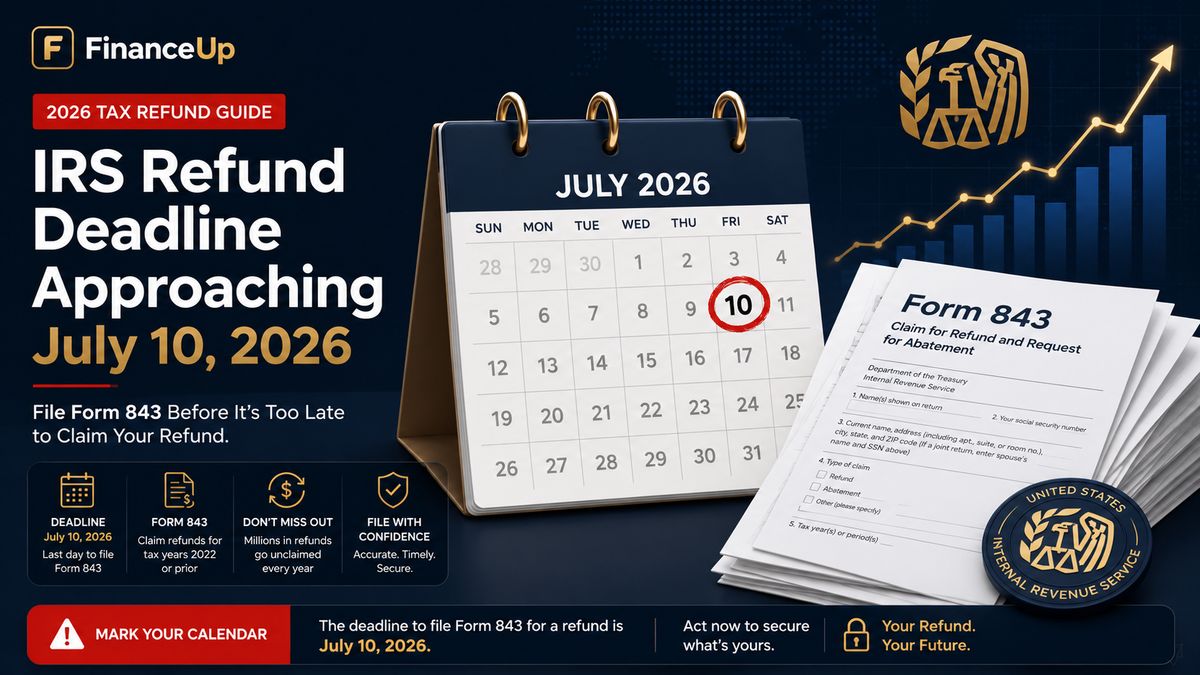
The Urgent July 10, 2026 Deadline: Why Taxpayers Must Act Now
If you were assessed and paid late-filing or late-payment penalties or interest by the Internal Revenue Service (IRS) during the COVID-19 pandemic, you have less than 48 hours to secure a potential refund. Under the statute of limitations, July 10, 2026, represents the final cutoff date to file a "protective claim" to claw back these funds.
This urgent deadline is the direct result of a landmark federal court case, *Kwong v. United States* (179 Fed. Cl. 382), which ruled that the IRS improperly charged penalties and interest during the pandemic. However, because the federal government is actively appealing this ruling, the IRS will not automatically send you a check. You must proactively file IRS Form 843 by the deadline to preserve your legal right to a refund. If you do not file by July 10, 2026, you will lose your claim forever—even if the court ultimately rules in favor of taxpayers.
This comprehensive guide details the legal mechanics of the Kwong case, outlines who qualifies for a refund, provides step-by-step instructions on filling out Form 843 online or on paper, and details where to send your claim to guarantee it is legally recorded.
The Legal Catalyst: What is Kwong v. United States?
To understand why this refund opportunity exists, we must examine the specific tax code provisions at the heart of the litigation.
In 2019, Congress enacted the SECURE Act, which added subsection (d) to Internal Revenue Code (IRC) Section 7508A. This provision was designed to standardize tax relief during major disasters. It states that if a federally declared disaster occurs, taxpayers in the disaster area are entitled to an automatic, mandatory 60-day postponement of tax filing and payment deadlines.
On March 13, 2020, the President declared the COVID-19 pandemic a national emergency and a major disaster. Under the statutory terms, this disaster period officially began on January 20, 2020, and ran until the national emergency declaration was terminated on May 11, 2023.
The Court's Ruling
In Kwong v. United States, the Court of Federal Claims evaluated whether the IRS had the authority to limit disaster extensions during the pandemic. The IRS had issued regulations (Treasury Reg. § 301.7508A-1(g)) attempting to restrict the mandatory postponement period to a maximum of one year, arguing that a multi-year emergency would disrupt normal tax collections.
The federal court rejected the IRS's regulations, holding that the plain language of IRC Section 7508A(d) is unambiguous, mandatory, and self-executing. The court ruled that:
- The automatic postponement applied to the entire duration of the COVID-19 disaster period (January 20, 2020 – May 11, 2023).
- Taxpayers were entitled to an automatic extension of all tax filing and payment deadlines falling within that window.
- Adding the statutory 60-day "tail" after the disaster ended on May 11, 2023, the postponed deadline for all affected returns and payments was pushed to July 10, 2023.
The Consequence
Because the legal deadlines were automatically postponed by statute to July 10, 2023, any late-filing or late-payment penalties (and the interest associated with them) assessed by the IRS for returns due during this period were legally invalid. For example, if you filed your 2020 tax return in late 2021 and were hit with a failure-to-file penalty, the Kwong ruling argues that your return wasn't actually late because your legal deadline had been extended to July 10, 2023.
Who is Eligible for a Refund?
Not everyone qualifies for a refund under Kwong. The eligibility is restricted to specific types of assessments and tax periods.
Qualifying Assessments
You are eligible to file a protective claim if you were assessed and paid:
- Failure-to-File (FTF) Penalties (IRC § 6651(a)(1)): Charged for filing your tax return after the deadline.
- Failure-to-Pay (FTP) Penalties (IRC § 6651(a)(2)): Charged for paying your tax liability after the due date.
- Assessed Interest: The interest that automatically accumulates on unpaid tax liabilities and penalties. Under IRC § 6601, interest can only accrue when a tax is unpaid after its legal due date. Since Kwong postpones the legal due date, interest assessed during the window is also invalid.
Qualifying Tax Periods
The deadline postponement applies to tax filing and payment obligations that fell due during the disaster period. This covers:
- Tax Years 2019, 2020, 2021, and 2022: Specifically, the original filing and payment deadlines that occurred between January 20, 2020, and May 11, 2023.
- Estimated Tax Payments: Quarterly estimated payments due during the emergency window.
Why You Must File a "Protective Claim" Immediately
If the court ruled that the penalties are invalid, why hasn't the IRS refunded the money?
The IRS is actively appealing the Kwong decision to the U.S. Court of Appeals for the Federal Circuit. The litigation is ongoing, and a final, binding decision is expected to take 12 to 24 months.
Because of this appeal, two scenarios exist:
- The Government Wins the Appeal: The Kwong ruling is overturned. No refunds are paid, and the status quo remains.
- The Taxpayers Win the Appeal: The Kwong ruling is upheld. The IRS is legally forced to refund the invalid penalties and interest.
The Statute of Limitations Catch
Under IRC Section 6511, taxpayers must file a claim for a refund within 3 years of filing their tax return or 2 years of paying the tax, whichever is later.
Because the court-mandated postponed deadline was July 10, 2023, the 3-year statute of limitations to request a refund for returns due during that period expires exactly on July 10, 2026.
If you do not file a claim by July 10, 2026:
- Your claim becomes barred by the statute of limitations.
- Even if the taxpayers win the appeal and the IRS issues billions in refunds, you will receive $0 because your claim was not filed in time.
What is a Protective Claim?
A protective claim is a formal request for a refund that is based on ongoing litigation. Filing a protective claim by July 10, 2026:
- Preserves your rights and suspends the statute of limitations.
- Tells the IRS: "Hold my request open. If the Kwong case is upheld, I want my refund."
- Places your claim in a pending/suspense status until the appeal is resolved.
Step-by-Step Instructions: How to File Form 843
Taxpayers have two ways to file a protective claim: electronically (for individuals) or via paper mail.
Method A: Electronic Filing (Fastest & Safest)
Individual taxpayers can now file a Kwong-related Form 843 protective claim electronically through their IRS Online Account. This is highly recommended because it provides an instant confirmation receipt and eliminates postal delays.
- Log In: Go to IRS.gov and log into your IRS Online Account.
- Locate Mobile Forms: Navigate to the "Mobile-Friendly Forms" page.
- Select Form 843: Click on "Form 843, Claim for Refund and Request for Abatement".
- Complete the Form: Input your details, referencing the Kwong case and IRC Section 7508A(d) as the reason (see line-by-line guide below).
- Submit: Sign and submit the form electronically. Save the PDF receipt for your records.
Method B: Paper Filing (Required for Businesses & Trusts)
If you cannot file electronically, you must mail a paper Form 843. To ensure the IRS routes your form to the correct protective claim unit, you must follow these instructions exactly:
Step 1: Print the Legend
At the very top of the paper Form 843, print the following text in bold, uppercase letters:
"PROTECTIVE REFUND CLAIM PURSUANT TO KWONG V. UNITED STATES"
Step 2: Line-by-Line Form Details
- Taxpayer Information: Enter your name, Social Security Number (or Employer Identification Number), and current mailing address.
- Line 1 (Tax Period): Enter the specific tax period for which you are claiming the refund. For example, if you are claiming a refund for the 2020 tax year, enter "12/31/2020". (Note: You must file a separate Form 843 for each individual tax year.)
- Line 2 (Amount to be Refunded): Enter the exact amount of the penalties and interest you paid. If you do not know the exact amount, write: "Estimated $100 or more, to be determined by IRS transcripts." This keeps the claim legally valid while allowing the IRS to compute the exact figure.
- Line 3 (Type of Tax): Check the box for "Income tax" (or the appropriate box if claiming for employment or corporate taxes).
- Line 4 (Type of Penalty/Interest): Check the boxes for "Interest" and/or "Penalties" as applicable.
- Line 5 (Reasonable Cause / Section): Write: "Mandatory statutory deadline postponement under IRC Section 7508A(d) and Kwong v. United States."
- Line 7 (Detailed Explanation): You must write a precise explanation of the claim. Copy and paste the following text:
"This is a protective refund claim filed pursuant to Treasury Regulation § 301.6402-2(b)(1) to preserve the taxpayer's right to a refund of failure-to-file and failure-to-pay penalties, and associated interest, assessed for the tax period ended [Insert Tax Period Date, e.g., 12/31/2020]. The claim is based on the court's holding in Kwong v. United States (179 Fed. Cl. 382), which ruled that IRC Section 7508A(d) automatically postponed tax deadlines during the COVID-19 disaster period from January 20, 2020, through July 10, 2023. The taxpayer requests a refund of all penalties and interest assessed during this period once the Kwong litigation is finalized."
Step 3: Sign and Date the Form
Do not forget to sign and date the form at the bottom. Unsigned tax forms are invalid and will be rejected by the IRS without tolling the statute of limitations.
Step 4: Where to Mail
Mail your completed, signed paper Form 843 to the Ogden IRS service center:
Mailing Address
The Certified Mail Rule
If you are mailing a paper Form 843, you must use Certified Mail with a Return Receipt Requested (or an approved private delivery service like FedEx/UPS with tracking).
- The IRS frequently loses paper correspondence.
- Under the "mailbox rule" (IRC § 7502), a document is considered filed on the postmark date.
- Your certified mail receipt is your only legal proof that you submitted the claim on or before July 10, 2026. Keep this receipt and the tracking logs in a safe place.
Summary Checklist for Taxpayers
To protect your potential refund before the clock runs out, complete these steps immediately:
- Pull Your IRS Transcripts: Log into your IRS Online Account and download your Account Transcripts for tax years 2019, 2020, 2021, and 2022. Look for transaction codes 160 (late filing penalty), 270 (late payment penalty), and 190 (interest assessed).
- Calculate Your Claim Amount: Sum up the penalties and interest you paid for each year.
- Draft Form 843: File electronically through your IRS portal, or draft a separate paper Form 843 for each affected tax year.
- Print the Kwong Legend: Write the protective claim label across the top of the paper forms.
- Mail via Certified Mail: Postmark the forms at a USPS office on or before July 10, 2026, and secure your certified mail receipt.
- Track the Claim: Monitor your mail for a notice of receipt or a "suspense" letter from the IRS, which confirms they are holding your claim pending the appeal.