
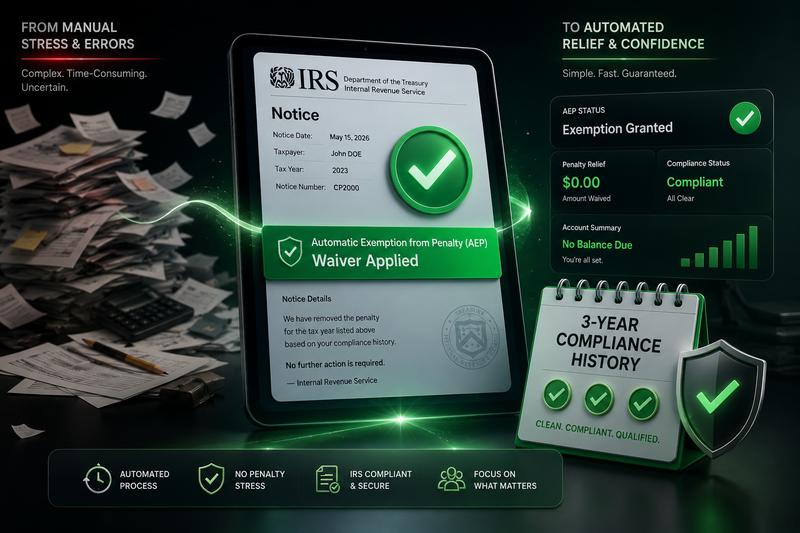
Introduction: The Systemic Revolution in IRS Tax Penalty Relief in 2026
On July 8, 2026, the Internal Revenue Service (IRS) officially launched one of the most significant administrative reforms in modern tax history: the Automatic Exemption from Penalty (AEP) program. Designed to streamline IRS core processing operations, reduce backlogs, and provide immediate financial relief to compliant taxpayers, the AEP program systemically identifies qualifying tax returns at the moment of posting and automatically waives common late filing and payment penalties.
Historically, taxpayers who made an honest mistake and faced late filing or payment penalties had to navigate a complex, time-consuming manual abatement process. This involved filing Form 843 (Claim for Refund and Request for Abatement), writing detailed explanation letters, or enduring hours on hold waiting for an IRS customer service representative to apply the legacy "First-Time Abate" (FTA) administrative waiver. Under the new 2026 AEP guidelines, the IRS's core computer systems automatically evaluate your tax compliance history when your return is processed. If you meet the criteria, the penalties are waived systemically, and the IRS issues a Notice CP47 to confirm the relief—requiring zero phone calls or paperwork from the taxpayer.
This comprehensive guide details the eligibility rules for the AEP program, analyzes how late penalties accrue under the Internal Revenue Code (IRC), walks through worked math examples across different taxpayer profiles, explains the treatment of interest charges, and outlines a step-by-step checklist for managing IRS penalty notices.
Summary of IRS AEP Parameters and Rules
| Feature | Legacy First-Time Abate (FTA) | New Automatic Exemption from Penalty (AEP) | Target IRS Notice Codes |
|---|---|---|---|
| Application Process | Manual (Form 843, calls, or letters) | 100% Automated (Systemic checks during processing) | CP14, CP47, CP501, CP504 |
| Compliance Period | Clean 3-year history prior to taxed year | Clean 3-year history (12 quarters for businesses) | N/A |
| Processing Timeline | 60 to 120 days of manual agent review | Instantaneous (applied upon posting return) | N/A |
| Underlying Interest | Adjusted manually; remains payable | Adjusted systemically; remains payable | IRC Section 6601 interest |
| Actions Required | Taxpayer must initiate request | None (system applies relief automatically) | N/A |
Important
The AEP program only waives penalties, not the underlying tax liability or interest. To estimate your potential penalties and check your eligibility for an automatic waiver, use our IRS Penalty Relief & AEP Calculator.
1. Statutory Eligibility Criteria: Do You Qualify for AEP?
To ensure that penalty relief is reserved for historically compliant taxpayers, the IRS systemic engine enforces strict eligibility criteria. The core algorithm checks the following five conditions before applying the systemic waiver:
1. The 3-Year Clean Compliance Rule
For individual taxpayers, your account must show no penalty assessments (excluding minor interest charges or estimated tax penalties) for the three tax years preceding the penalized year. For corporate and business filers, the compliance history is evaluated over the preceding 12 fiscal quarters.
2. Up-to-Date Filing Requirements
All required tax returns for preceding years must be filed. If you have an outstanding unfiled return (e.g., you failed to file a return for 2023), the AEP system will flag the account as non-compliant and withhold the waiver until all delinquent returns are submitted.
3. Payment or Agreement Mandate
The underlying tax liability for the penalized year must be satisfied in full, or you must be in compliance with an active IRS payment plan, such as an Installment Agreement or an approved Offer in Compromise (OIC).
4. Tax Return Types
AEP is integrated across major tax classes, including:
- Form 1040: Individual Income Tax Returns
- Form 1120: Corporate Income Tax Returns
- Form 1065: Partnership Returns (protecting partners from Failure to File penalties)
- Form 1120-S: S-Corporation Returns
5. Prior Waiver Limit
You cannot have received a penalty waiver (either legacy FTA or automatic AEP) for the same tax type on the same account within the preceding three tax years. AEP is designed as a one-time relief mechanism for occasional mistakes, not a recurring benefit.
2. Understanding the Math: How Late Penalties Accrue
To understand the financial value of the AEP program, it is essential to understand how penalties are calculated under the Internal Revenue Code (IRC).
1. Failure to File (FTF) Penalty (IRC Section 6651(a)(1))
If you fail to file your tax return by the due date (including extensions), the IRS assesses a Failure to File penalty. The penalty is 5% of the unpaid taxes for each month or part of a month the return is late, capped at a maximum of 25%.
- The 60-Day Minimum: If you file your return more than 60 days late, the minimum FTF penalty is the lesser of $485 (for tax year 2026) or 100% of the unpaid tax.
2. Failure to Pay (FTP) Penalty (IRC Section 6651(a)(2))
If you fail to pay the tax shown on your return by the due date, the IRS assesses a Failure to Pay penalty. The penalty is 0.5% of the unpaid taxes for each month or part of a month the tax remains unpaid, capped at 25%.
- Levy Notice Increase: The FTP rate increases to 1.0% per month if the tax remains unpaid 10 days after the IRS issues a Notice of Intent to Levy.
- Payment Plan Decrease: The FTP rate decreases to 0.25% per month for any month an installment agreement is in effect, provided the return was filed on time.
3. Stacking Rules (The 5% Combined Cap)
When both the Failure to File and Failure to Pay penalties apply in the same month, the 5% monthly Failure to File penalty is reduced by the 0.5% Failure to Pay penalty. Therefore, the combined penalty is 5% per month (4.5% FTF + 0.5% FTP) for the first five months, after which the FTF penalty caps at 22.5% (plus 2.5% FTP, reaching the 25% combined limit). If the tax remains unpaid after five months, the FTP penalty continues to accrue at 0.5% per month up to its individual 25% cap.
3. Worked Math Examples: 3 Taxpayer Profiles
Let's model the math behind penalty accrual and AEP eligibility across three distinct taxpayer scenarios.
Profile A: Individual Taxpayer (Sarah - Full AEP Waiver)
Sarah owes $12,000 in unpaid taxes for the 2025 tax year. She files her return and pays the balance 4 months late without securing a filing extension. She has a clean compliance history for 2022, 2023, and 2024.
- Failure to File (FTF): $12,000 4.5% 4 months = $2,160.
- Failure to Pay (FTP): $12,000 0.5% 4 months = $240.
- Total Penalties Accrued: $2,400.
- AEP Application: Because Sarah has a clean 3-year record, the IRS core system automatically applies the AEP waiver at return processing. The penalties are reduced to $0.
- Net Savings: Sarah saves $2,400.
Profile B: Business Taxpayer (Apex Corp - Corporate AEP Waiver)
Apex Corp owes $50,000 in federal corporate taxes. The company files its Form 1120 and pays the tax 3 months late due to a cash flow disruption. Apex Corp has filed all required forms and paid all taxes on time for the preceding 12 quarters.
- Failure to File (FTF): $50,000 4.5% 3 months = $6,750.
- Failure to Pay (FTP): $50,000 0.5% 3 months = $750.
- Total Penalties Accrued: $7,500.
- AEP Application: As a corporate filer with a clean 12-quarter history, Apex Corp qualifies for the business AEP waiver. The IRS systemic engine waives the penalties on processing, adjusting the balance to $0.
- Net Savings: Apex Corp saves $7,500.
Profile C: Non-Compliant Taxpayer (David - Ineligible for AEP)
David owes $8,000 in unpaid taxes for 2025. He files and pays 5 months late. However, David's tax transcript shows that he was assessed a late filing penalty in 2023, which he paid.
- Failure to File (FTF): $8,000 4.5% 5 months = $1,800.
- Failure to Pay (FTP): $8,000 0.5% 5 months = $200.
- Total Penalties Accrued: $2,000.
- AEP Application: David does not qualify for AEP because his compliance history for the preceding 3 years is not clean. He must pay the $2,000 penalty in full, or submit a manual request for penalty abatement using Form 843, arguing "Reasonable Cause" (such as serious illness or natural disaster), which is subject to strict IRS review and approval.
4. The Unwaivable Interest Charge (IRC Section 6601)
Taxpayers must remember that the AEP program only waives penalties. It does not waive interest. Under IRC Section 6601, the IRS is legally required to charge interest on unpaid taxes and penalties from the original due date of the return until the date of payment. The interest rate is established quarterly and is equal to the federal short-term rate plus 3%, compounding daily.
Even if Sarah (Profile A) receives a full AEP waiver for her $2,400 penalty, she will still receive a bill for the interest accrued on the $12,000 tax balance from April 15 until the date her payment was posted. Interest is statutory and cannot be abated for administrative reasons.
5. Step-by-Step Checklist for Managing IRS Penalty Notices
If you receive a penalty notice from the IRS, follow these steps to verify your AEP status:
- Check the Notice Code: Look at the notice code in the top right corner of the document. Standard codes include CP14 (Balance Due), CP47 (AEP Waiver Applied), and CP161 (Business Balance Due).
- Verify Compliance History: Log into your IRS Online Account at irs.gov to confirm that your preceding 3 tax years show no penalty assessments.
- Confirm Waiver on Notice: Review the notice line items to verify if an "Administrative Waiver" or "Penalty Relief" credit is shown. If the credit matches the penalty amount, AEP has successfully applied.
- Submit Form 843 if Necessary: If you qualify for AEP but the notice does not reflect the waiver, the automated system may have failed to process it. In this case, file Form 843 by mail, writing "First-Time Abate / Automatic Exemption from Penalty eligibility under IRM 20.1.1.3.3.2.1" at the top, to request manual abatement.
- Establish a Payment Plan: If you cannot pay the tax in full, set up an Installment Agreement immediately to reduce the Failure to Pay penalty rate from 0.5% to 0.25% per month.