
Navigating Singapore's CPF Reforms: 2026, 2027, and 2028
Singapore's Central Provident Fund (CPF) system is undergoing several structural updates aimed at enhancing retirement adequacy for workers, particularly seniors, and introducing new investment options. As life expectancies rise and living costs increase, the government is updating contribution ceilings and matching schemes to ensure Singaporeans accumulate a sufficient retirement nest egg.
Here is a comprehensive breakdown of the major changes taking place in 2026, as well as what is scheduled for 2027 and 2028. Understanding these changes allows individuals to perform accurate retirement planning, adjust their take-home pay expectations, and optimize their CPF investment strategies.
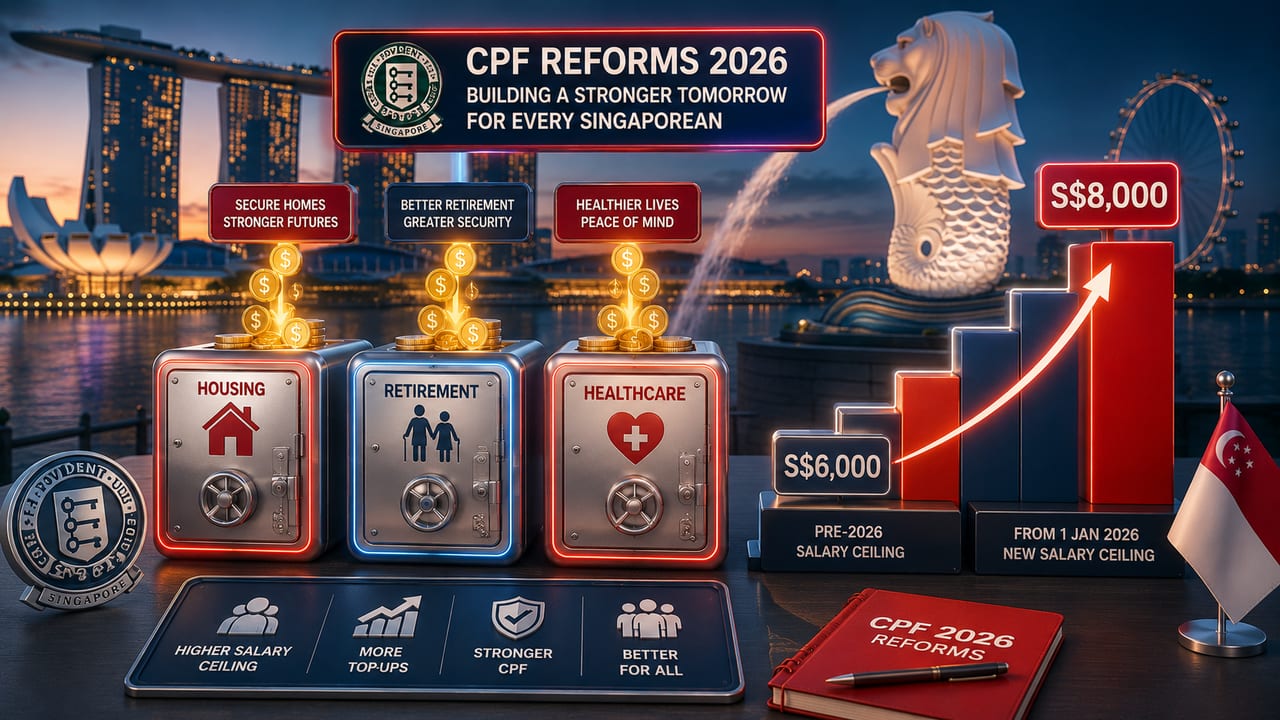
1. Ordinary Wage (OW) Salary Ceiling Reaches Final Target of S$8,000 (Jan 2026)
In the Singapore Budget 2023, the government announced a phased increase in the CPF monthly Ordinary Wage (OW) salary ceiling from S$6,000 to S$8,000 by 2026. This phase-in is now complete:
- Effective 1 January 2026: The monthly Ordinary Wage salary ceiling is S$8,000 (up from S$7,400 in 2025).
- Annual Salary Ceiling: Remains unchanged at S$102,000 (which includes both Ordinary Wages and Additional Wages like year-end bonuses).
What This Means for You
If you earn a monthly salary of S$8,000 or more:
- Deductions: Both you and your employer will contribute CPF based on a monthly salary cap of S$8,000.
- Monthly Contributions: For a worker aged 55 or below, your employee contribution (20%) is capped at S$1,600/month, and your employer's contribution (17%) is capped at S$1,360/month, totaling S$2,960/month in CPF savings. This represents an increase of S$222 per month in total savings compared to 2025 limits.
- Take-Home Pay: If you earn S$8,000 or more, your employee contribution increases from S$1,480 to S$1,600, resulting in a minor reduction of S$120 in monthly take-home pay. However, your employer's contribution also rises by S$102/month, representing a net increase in your total compensation package.
2. Budget 2026 Senior CPF Top-Ups (December 2026)
To support the retirement needs of the "transition generation" of older workers who had fewer years to benefit from the higher salary ceilings, Singapore's Budget 2026 introduces a one-time CPF top-up:
Note
In December 2026, eligible Singaporean citizens aged 50 and above (born in 1976 or earlier) will receive a one-time CPF retirement top-up of up to S$1,500 deposited directly into their CPF accounts. The exact amount is tiered based on means testing: seniors will receive S$500, S$1,000, or S$1,500 depending on their CPF retirement savings balance and the Annual Value (AV) of their residence. Seniors who own more than one property are not eligible for this top-up. This top-up is designed to help mid-career and older citizens build up their retirement balances, splitting the deposit between the Special Account (SA) and Retirement Account (RA) depending on age and account status.
3. Senior Worker CPF Contribution Rate Hikes (January 2027)
Following the recommendations of the Tripartite Committee on Senior Work, the government is gradually raising the CPF contribution rates for workers aged 55 to 65. The next rate hike is scheduled to take place on 1 January 2027:
- Age 55 to 60: The total contribution rate will increase by 1.5% (split 1.0% from the employee and 0.5% from the employer). This brings the total rate for this bracket closer to the full 37% rate of younger cohorts.
- Age 60 to 65: The total contribution rate will increase by 1.0% (split 0.5% from the employee and 0.5% from the employer to support senior worker employability while ensuring additional retirement accumulation).
These rate increases ensure that senior workers continue to accumulate meaningful retirement savings during their peak working years, helping them offset the closure of the Special Account at age 55.
4. Launch of the Voluntary CPF Lifecycle Investment Scheme (2028)
To offer CPF members a simplified way to invest their CPF Ordinary Account (OA) balances, the Ministry of Manpower is introducing the Voluntary CPF Lifecycle Investment Scheme starting in 2028:
- Target-Date Concept: This scheme operates similarly to commercial target-date funds, where the investment allocation automatically shifts over time. When you are younger, the fund is allocated aggressively in global equities for high growth; as you approach retirement age, the fund automatically reallocates to safer, conservative fixed-income assets to protect capital.
- Hurdle Rate: This scheme provides an alternative to the default CPFIS unit trusts, aiming to make long-term investing easier for members who do not wish to actively manage their portfolios but want to achieve returns exceeding the default 2.5% OA rate. By automating the risk-glidepath, it protects older savers from stock market volatility near retirement.
CPF Shielding and Retirement Optimization in 2026
Given the closure of the Special Account (SA) for members aged 55 and above (implemented in 2025), traditional CPF shielding strategies have fundamentally changed. Historically, shielding involved investing Special Account (SA) funds—not Ordinary Account funds—through CPFIS-SA before turning 55. The goal was to keep SA investments intact, forcing the Retirement Account (RA) to be formed using lower-interest OA balances instead. After age 55, the SA investments would be liquidated back into the SA, generating high interest (4.0%+) on those funds.
However, under the 2025 SA closure rule, this strategy is now largely obsolete. When members turn 55, any remaining CPFIS-SA investments are liquidated, and the proceeds are used to form the Retirement Account (RA) up to the Full Retirement Sum (FRS). Any amount exceeding the FRS is transferred to the Ordinary Account (OA), not back to a high-interest SA. As a result, members can no longer preserve SA balances post-55 through shielding.
Instead, retirement optimization in 2026 should focus on:
- Maximizing RA Top-Ups: Make voluntary cash top-ups to your Retirement Account (RA) under the Retirement Sum Topping-Up (RSTU) scheme to reach the Enhanced Retirement Sum (ERS), securing higher monthly lifelong payouts under CPF LIFE.
- Tax Relief: RSTU contributions qualify for tax relief of up to S$8,000 for self top-ups and S$8,000 for loved ones, providing both immediate tax savings and long-term retirement security.
- Strategic OA Investment: For members below 55, consider allocating OA funds to diversified CPFIS instruments to potentially exceed the 2.5% default OA interest rate, keeping in mind the upcoming 2028 Lifecycle Investment Scheme as a simplified auto-rebalancing option.
Summary of Key Actions for Singaporeans
To optimize your CPF contributions under the 2026 framework:
- Adjust Personal Budgets: If you earn above S$7,400, budget for the S$120/month decrease in take-home pay due to the monthly OW ceiling reaching S$8,000.
- Leverage RSTU: Make voluntary top-ups to your or your family members' Special or Retirement Accounts to secure tax relief of up to S$8,000 for self top-ups and S$8,000 for loved ones.
- Evaluate Investment Options: Prepare for the 2028 Lifecycle Investment Scheme by reviewing your current CPFIS allocations and ensuring your risk tolerance matches your retirement timeline.