
The Landmark Tax Simplification of 2026: Simplifying Work Claims for Millions
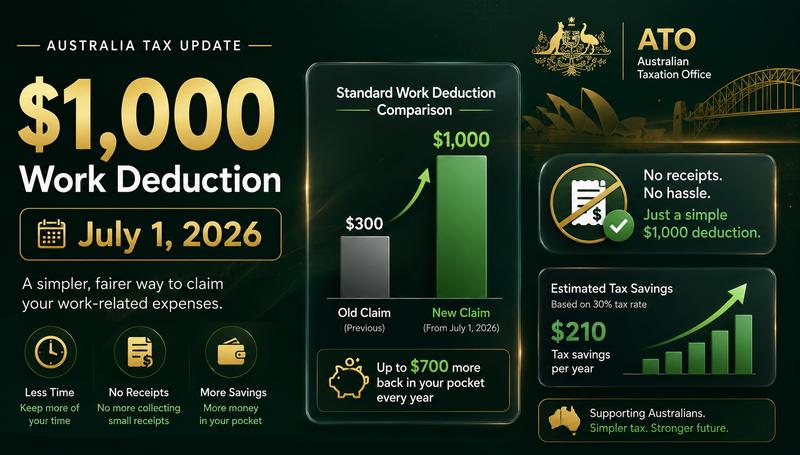
On July 1, 2026, the Australian tax landscape underwent one of its most significant structural changes in decades. The federal government officially introduced the standard deduction of up to $1,000 for work-related expenses. This new measure represents a major victory for tax simplification, directly affecting over 6.2 million salaried workers across the country.
Historically, claiming work-related deductions in Australia has been a source of administrative headache. The Australian Taxation Office (ATO) has long enforced strict substantiation rules, requiring taxpayers to keep physical or digital receipts, logbooks, and diaries for every dollar claimed if their total work-related expenses exceeded $300.
The new $1,000 standard deduction changes everything. Taxpayers earning salary and wages can now claim a flat deduction of $1,000 on their tax returns without the need to track, store, or submit receipts. However, because this is a tax deduction rather than a tax offset or refund, the actual money you save depends entirely on your progressive income bracket and the recently adjusted Stage 3 tax cuts.
This comprehensive guide breaks down the mechanics of the new standard deduction, explains how it compares to the old $300 no-receipt rule, models the tax savings mathematically across different salary brackets, and provides a step-by-step strategy for choosing the optimal filing method.
Timing and Implementation: Which Tax Return Does This Apply To?
Before diving into calculations, it is critical to clarify a common source of confusion regarding the implementation timeline:
- Commencement Date: The legislation officially took effect on 1 July 2026 (the start of the 2026–27 financial year).
- The 2025–26 Tax Season (Current Filing): If you are currently lodging your tax return for the financial year that ended on 30 June 2026 (FY 2025–26), the $1,000 standard deduction is not available. For this return, you must continue to follow the old rules, including the standard $300 no-receipt limit.
- The 2026–27 Tax Season (First Claimable in 2027): The standard deduction will be first available for use when you lodge your tax return in July 2027, covering the income earned between 1 July 2026 and 30 June 2027.
Planning ahead is essential because the record-keeping choices you make today will dictate which method you should use when filing next year.
Standard Deduction vs. Actual Expenses: The Crucial Choice
The standard deduction is not an automatic, extra $1,000 given to everyone. It is an optional alternative to the existing system. When lodging your return for the 2026–27 income year, you must choose between two mutually exclusive options:
Option A: The $1,000 Standard Deduction
- You claim a flat $1,000 for work-related expenses.
- No Substantiation Required: You do not need to keep receipts, logs, or diary entries.
- Exclusions Apply: This standard deduction replaces all claims for standard work-related expenses, including home office costs, work uniforms, mobile phone bills, self-education expenses, and tools/equipment.
- Note: You can still claim other non-work deductions (such as charitable donations or tax agent fees) on top of this standard deduction.
Option B: Actual Work-Related Expenses
- You claim the exact dollar amount you spent during the year (e.g., $1,450).
- Substantiation Required: You must have written evidence (receipts, logbooks, utility bills) for the entire amount claimed—not just the amount exceeding $1,000.
- If your actual expenses are less than $1,000, choosing this option makes no sense, as the standard deduction yields a larger tax benefit with zero record-keeping.
Side-by-Side Comparison: The Old $300 Rule vs. The New $1,000 Rule
To understand the magnitude of this change, let us compare the new rules with the historical $300 limit:
| Feature | Old Rules (Up to FY 2025-26) | New Rules (From FY 2026-27 Onward) |
|---|---|---|
| No-Receipt Limit | $300 (total across all work expenses) | $1,000 (standard deduction) |
| If Claim Exceeds Limit | Must have receipts for the entire claim (e.g. if claiming $350, you must prove all $350). | Must have receipts for the entire claim (e.g. if claiming $1,200, you must prove all $1,200). |
| Actual Spending Proof | Technically, you still had to spend the money and have a diary or calculation log if audited. | No individual receipt verification is conducted; the standard $1,000 is accepted for wage earners. |
| Extra Deductions Allowed | Charity, union fees, and interest were separate. | Charity, union fees, and interest remain separate and can be claimed on top. |
The Mathematics of Tax Savings: Stage 3 Cuts & Deductions
Because a tax deduction reduces your taxable income rather than directly paying off your tax bill, the actual cash value of the deduction is determined by your marginal tax rate. In Australia, your final tax rate consists of your progressive income tax bracket plus the 2.0% Medicare Levy.
Starting in 2024 and continuing into the 2026–27 tax year, the Stage 3 tax cuts are fully active, modifying the marginal rates for millions of middle-income earners. The tax brackets (excluding Medicare Levy) are:
- $0 to $18,200: 0%
- $18,201 to $45,000: 15%
- $45,001 to $135,000: 30%
- $135,001 to $190,000: 37%
- Above $190,000: 45%
The Mathematical Formula for Tax Savings
To find out how much a deduction saves you in actual cash, use the following equation:
```
Tax Savings = Claim Amount x (Marginal Tax Rate + Medicare Levy Rate)
```
For example, if you earn $85,000, your marginal tax rate is 30% and the Medicare Levy is 2%, giving you an effective tax benefit rate of 32%. Every dollar of deduction reduces your tax bill by 32 cents.
Case Studies: Modeling the Cash Outcomes
Let us analyze three different taxpayer profiles to see how the new rules affect their final tax bills compared to the old $300 no-receipt limit.
- Case Study 1 (Sarah - Retail Assistant): Sarah's 17% effective rate means her savings increase from $51 (old rule) to $170 (new rule), a net benefit of +$119.
- Case Study 2 (Mark - Teacher): Mark's 32% effective rate means his savings increase from $96 (old rule) to $320 (new rule), a net benefit of +$224.
- Case Study 3 (David - Engineer): David's 39% effective rate means his savings increase from $117 (old rule) to $390 (new rule), a net benefit of +$273.
Comparison Table: Cash Savings by Salary Level
Here is a complete breakdown of the tax savings generated by the standard deduction transition across different income levels, assuming standard tax rates and Medicare Levy apply:
| Salary (AUD) | Marginal Tax Rate | Combined Rate (+2% Levy) | Old Savings ($300 Claim) | New Savings ($1,000 Claim) | Additional Cash Saved |
|---|---|---|---|---|---|
| $15,000 | 0% | 0% | $0 | $0 | $0 |
| $35,000 | 15% | 17% | $51 | $170 | $119 |
| $75,000 | 30% | 32% | $96 | $320 | $224 |
| $120,000 | 30% | 32% | $96 | $320 | $224 |
| $160,000 | 37% | 39% | $117 | $390 | $273 |
| $210,000 | 45% | 47% | $141 | $470 | $329 |
Note: High-income earners may also face the Medicare Levy Surcharge (an extra 1% to 1.5%) if they do not have private hospital insurance. For these individuals, the tax savings rate increases further, up to 48.5% for salaries above $190,000, making a $1,000 claim worth up to $485 in direct tax reductions.
What Specific Expenses Are Replaced by the Standard Deduction?
If you choose to claim the $1,000 standard deduction, you cannot claim actual expenses for the following categories. They are considered fully covered by the standard claim:
- Home Office and Working from Home (WFH): Internet bills, electricity, heating/cooling, printer ink, and phone expenses. (You can no longer use the 67c/hour fixed-rate method or actual cost method on top of the standard deduction).
- Uniforms and Work Clothing: Buying, dry-cleaning, or laundering protective clothing, occupation-specific uniforms, or hi-vis workwear.
- Tools and Equipment: Immediate deductions for items costing under $300 (such as calculators, software, safety gear, or trade tools) and depreciation for items costing over $300.
- Self-Education and Training: Textbooks, course fees, and travel costs directly related to maintaining or improving skills in your current employment.
What Can You Still Claim on Top?
Certain deductions are not classified as work-related expenses and can be claimed in full even if you use the standard deduction:
- Charitable Donations: Any gifts or donations of $2 or more to Registered Deductible Gift Recipients (DGRs).
- Union and Professional Association Fees: Fees paid to professional bodies, trade unions, or industry associations.
- Tax Agent Fees: The cost of hiring a registered tax agent to prepare and lodge your previous year's tax return, plus travel costs to visit them.
- Interest and Dividend Deductions: Interest on investment loans or costs associated with managing share portfolios.
ATO Compliance and Audit Safeguards
While the standard deduction simplifies your return by removing the requirement to submit receipts, it does not mean the ATO has turned off its compliance filters. Taxpayers must still adhere to key legal safeguards:
- Nexus of Employment: The deduction is only available if you are earning assessable labour income. If you are unemployed, retired, or only earning investment income, you cannot claim the standard deduction.
- No Double Dipping: If your employer paid for or reimbursed you for your WFH setup, mobile phone, or uniforms, you did not incur the expense out-of-pocket. Claiming a standard deduction in this scenario is invalid.
- Honest Choices: If your actual expenses are $200 and you have no receipts, you can legally claim the $1,000 standard deduction. However, if the ATO audits your employer and finds that they provided all tools, uniforms, and paid for all home office utilities directly, your eligibility for the deduction could be reviewed.
Summary Checklist for Australian Taxpayers
To optimize your next tax return under the new system, follow this action plan:
- Monitor WFH Hours: Keep a simple log of hours you work from home. If you work high WFH hours, the actual cost method or fixed-rate method might exceed $1,000.
- Track Major Purchases: If you buy a computer, phone, or expensive trade tools costing over $300, keep the receipts. These might push your actual expenses above the $1,000 threshold.
- Run the Comparison: At the end of the financial year, add up your actual expenses. If they are under $1,000, shred the receipt clutter and claim the flat $1,000 standard deduction.
- Claim Extra Deductions: Remember to declare your charity donations, union fees, and tax prep costs separately to maximize your tax refund.