
Introduction: APRA's New Lending Guardrail Reshapes Australian Borrowing in 2026
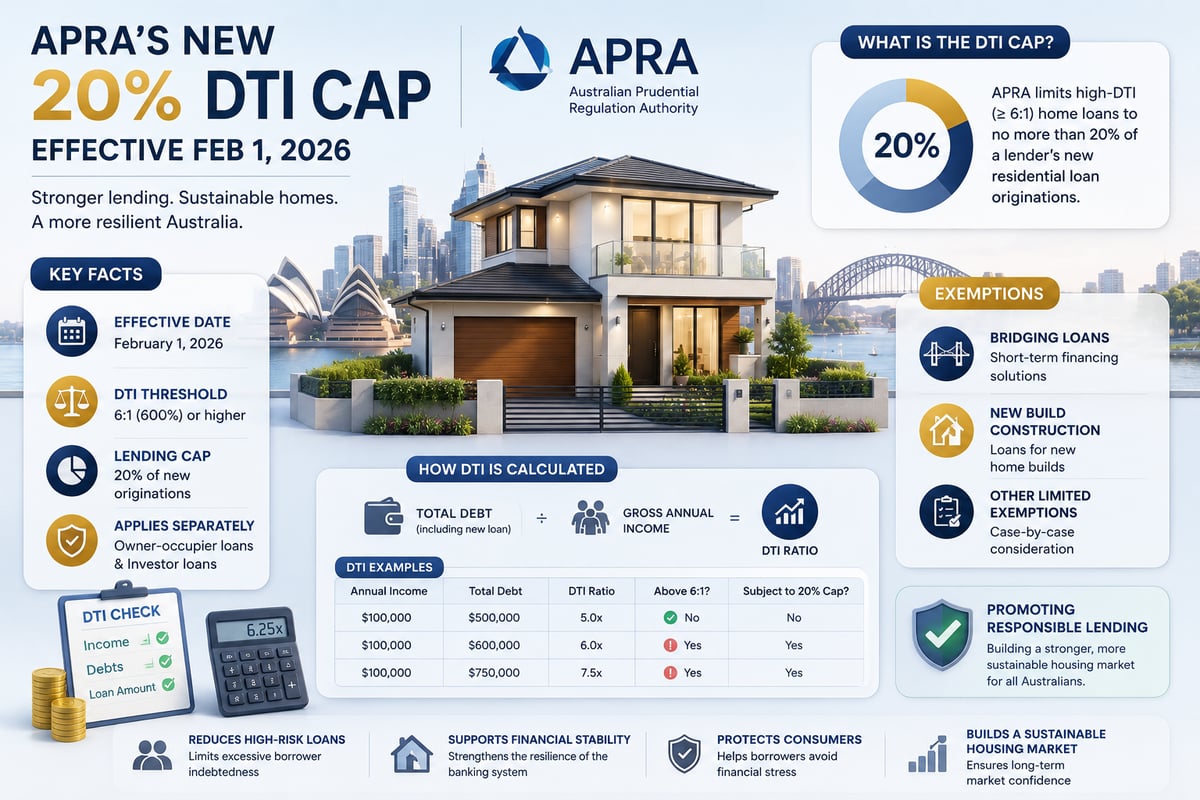
On 27 November 2025, the Australian Prudential Regulation Authority (APRA) announced a landmark macroprudential policy shift — the activation of a formal debt-to-income (DTI) lending limit for the first time in Australia's history. Effective 1 February 2026, this rule requires all authorised deposit-taking institutions (ADIs) — the banks, building societies, and credit unions that dominate Australia's mortgage market — to cap the proportion of new high-DTI loans at 20% of their quarterly lending, measured independently across owner-occupier and investor portfolios.
The trigger for this intervention was not a crisis, but an early warning signal. Investor lending surged 18% in the September 2025 quarter alone, housing credit growth accelerated above its long-term average, and national median dwelling prices reached $912,465 (CoreLogic, January 2026). With the Reserve Bank of Australia (RBA) raising the cash rate to 3.85% just two days after the cap took effect, the combination of tighter lending standards and higher borrowing costs has created a materially new environment for Australian borrowers, particularly property investors seeking to expand their portfolios.
This comprehensive guide explains exactly how the APRA DTI cap works — the 6:1 threshold mechanics, the separate investor versus owner-occupier quotas, the strategic exemptions for new builds and bridging loans, how it differs from the existing 3% serviceability buffer, and actionable strategies to navigate the new lending landscape. Whether you are a first-home buyer, an upgrad-er, or a portfolio investor, understanding these rules is essential for your borrowing strategy in 2026 and beyond.
Quick Summary of APRA's 2026 DTI Cap
- Effective Date: 1 February 2026
- DTI Threshold: 6:1 (total debt >= 6x gross annual income = high-DTI zone)
- Lending Cap: 20% of new quarterly mortgage lending per ADI
- Separate Caps: Applied independently to owner-occupier and investor loan portfolios
- Exemptions: Bridging loans (owner-occupier) and loans for new dwelling construction or purchase
- Non-Bank Lenders: Pepper Money, Liberty Financial, Resimac, La Trobe Financial — not subject to APRA DTI cap
- Serviceability Buffer: Remains at 3% above actual loan rate (unchanged)
- Current High-DTI Share: ~6.1% of new lending (well below the 20% cap as of early 2026)
What Is the APRA DTI Cap and Why Was It Introduced?
A debt-to-income (DTI) ratio measures a borrower's total debt against their gross annual income. A DTI of 6x means total borrowings of $600,000 on a $100,000 gross income. APRA considers DTI ratios at or above 6:1 as the threshold beyond which household leverage becomes systemically riskier — more sensitive to interest rate changes, employment shocks, and rental income disruptions.
The DTI cap is a macroprudential tool — a regulatory guardrail designed not to restrict lending in normal conditions but to prevent the build-up of vulnerabilities during periods of rising credit growth. APRA has been explicit that the measure is pre-emptive: "While overall bank lending standards remain sound, APRA has observed a pick-up in some riskier forms of lending over recent months as interest rates have fallen, housing credit growth has picked up to above its longer-term average and housing prices have risen further."
Australia is not alone in using DTI limits. New Zealand has a DTI limit between 6x and 7x, while Ireland and Canada apply even tighter restrictions. Australia's 20% cap with a 6x threshold is relatively generous by international standards, reflecting APRA's stated intent to curb the most aggressive high-debt borrowing without dramatically restricting overall credit access.
The Regulatory Context: Two Complementary Tools
The DTI cap works alongside APRA's existing macroprudential framework. The 3% serviceability buffer (introduced in 2021, confirmed unchanged in 2026) requires banks to assess borrowers at the actual loan rate plus 3 percentage points. With variable rates at 6.10–6.60% following the March 2026 RBA rate increase, banks test borrower capacity at assessment rates of 9.10–9.60%. The counter-cyclical capital buffer remains at 1% of risk-weighted assets.
| Factor | DTI Cap (New, Feb 2026) | Serviceability Buffer (Ongoing) |
|---|---|---|
| What It Measures | Total debt / gross income | Ability to repay if rates rise 3% |
| The Threshold | >=6x income = high-DTI zone | Assessed at loan rate + 3% |
| How It Restricts | Lender quarterly quota (20% max) | Reduces max. borrowing amount |
| Who Is Most Affected | Portfolio investors, high-leverage borrowers | All borrowers universally |
| Applies to Non-Banks? | No | No (but many apply internal buffers) |
How the DTI Cap Works in Practice
The 20% cap applies to new lending only — not to existing mortgage books. This means banks must carefully track and manage their quarterly origination volumes to ensure that no more than one in five dollars of new mortgage lending goes to borrowers with DTI >= 6. The cap is measured separately for owner-occupier and investor loans, meaning banks cannot cross-subsidise between the two pools.
Calculating Your DTI Ratio
Your DTI ratio is calculated as:
DTI = Total Existing Debt / Gross Annual Income
For example:
- Gross annual income: $120,000
- Existing mortgage: $540,000
- Credit card limits (if assessed at 3% of limit): $3,000
- Personal loan: $15,000
- Total debt: $558,000
- DTI ratio: 4.65x (below the 6x threshold)
If this borrower applied for an additional $200,000 investment loan:
- Total debt would rise to $758,000
- DTI would rise to 6.32x (entering the high-DTI zone)
- The bank could still approve it, but only if it has remaining capacity within its 20% quarterly quota
The Bank Perspective: Quota Management
Each ADI must manage its quarterly high-DTI lending allocation. As of early 2026, only 6.1% of new ADI lending was at DTI >= 6, well below the 20% cap. However, as the RBA cuts rates (which increases borrowing capacity and therefore DTI ratios), the proportion of high-DTI lending is expected to rise. The Property Investment Professionals of Australia estimates that every 1% reduction in interest rates increases DTI by approximately 0.5x for leveraged borrowers.
Banks retain full discretion over which high-DTI borrowers they approve within the 20% allocation. This means that even financially sound borrowers with high DTIs may be declined late in a quarter if a lender's quota is exhausted, creating a timing dynamic that borrowers must navigate with their mortgage brokers.
Who Is Affected by the DTI Cap?
Owner-Occupiers and First-Home Buyers (Minimal Impact)
Most owner-occupier borrowers currently sit at DTI ratios around 5x, comfortably below the 6x threshold. The Canstar analysis notes that the proportion of high-DTI owner-occupier loans is approximately 4% of new lending, far below the 20% cap. First-home buyers, who typically purchase more modestly priced properties relative to their future income trajectory, are unlikely to encounter the DTI cap as a binding constraint in the near term.
Property Investors (Primary Target)
Investors are squarely in APRA's crosshairs. Approximately 10% of all investor loans exceed the 6x DTI threshold, compared to just 4% of owner-occupier loans. With investor lending accounting for 40.6% of all new mortgage origination ($39.8 billion out of $98.0 billion in the September 2025 quarter), the investor segment represents the primary channel through which systemic risk could build.
Portfolio investors with multiple existing mortgages are the most exposed. A borrower with three investment properties each carrying $400,000 in debt on a $150,000 income would have a DTI of 8x, well into the high-DTI zone. Such borrowers would need to access non-bank lenders or restructure their portfolio to proceed with additional purchases.
Who Is Exempt?
APRA has carved out two key exemptions from the DTI cap:
- Bridging Loans (Owner-Occupier): Temporary loans used to finance a new home purchase before selling the existing home. These are exempt because they are short-term by nature and do not represent a permanent increase in household leverage.
- New Dwelling Construction or Purchase: Loans financing the construction or purchase of newly built homes. This exemption is intentional — APRA wants to avoid constraining housing supply. By channelling high-DTI borrowers toward new builds, the policy supports the government's broader housing supply agenda while still managing systemic risk.
The Non-Bank Alternative: A Growing Channel
Non-bank lenders — including Pepper Money, Liberty Financial, La Trobe Financial, Firstmac, RedZed, and Resimac — are not subject to APRA's DTI cap because they are not authorised deposit-taking institutions. This creates a significant alternative channel for high-DTI borrowers who find their bank's quarterly quota exhausted.
However, there are trade-offs:
- Higher interest rates: Non-bank lenders typically charge 0.50–1.50% more than ADIs for comparable loans
- Different underwriting: Many non-banks use their own serviceability models, often with lower buffers than the 3% APRA requirement
- Lender's Mortgage Insurance (LMI): May be required for higher LVR loans through non-bank channels
- Less brand recognition: Some borrowers prefer the stability of a major bank
As of 2026, non-bank lending comprises approximately 4% of total mortgage lending, a share that is expected to grow as the DTI cap redirects high-DTI demand away from ADIs.
Strategic Implications for 2026 Borrowing
Strategy 1: Calculate Your DTI in Advance
Know your exact DTI ratio before approaching a lender. This includes all mortgage debt, personal loans, car loans, and credit card limits (lenders typically assess 3% of the credit limit as a monthly liability). The calculator below helps you model your current DTI and determine whether a new loan would push you into the high-DTI zone.
Strategy 2: Target New Build and Construction Loans
The new-build exemption is the most powerful strategic tool for investors approaching the 6x DTI threshold. By channelling additional borrowing toward off-the-plan purchases, construction finance, or newly completed dwellings, investors can bypass the 20% cap entirely. This aligns with APRA's stated objective of supporting housing supply while managing risk.
Strategy 3: Monitor Lender Quota Capacity
Work with a mortgage broker who tracks individual lenders' quarterly high-DTI allocation. Some lenders may exhaust their 20% quota early in a quarter, while others may have capacity late in the period. Timing your application strategically can mean the difference between approval and a "not this quarter" response.
Strategy 4: Consider Debt Recycling
Debt recycling — converting non-deductible mortgage debt into deductible investment debt by using redraw or offset funds to purchase income-producing assets — can improve your overall financial position without necessarily increasing your DTI. However, lenders' treatment of redraw versus offset accounts for DTI purposes varies, so seek professional advice.
Strategy 5: Explore Non-Bank Lenders
If your DTI exceeds 6x and your preferred bank has exhausted its quota, non-bank lenders offer a viable alternative. The higher interest rate must be weighed against the investment opportunity. For time-sensitive purchases or refinancing needs, the non-bank channel can save a deal that would otherwise fall through.
Comparison: Australia vs International DTI Limits
Australia's approach is relatively accommodative compared to other economies:
- New Zealand: DTI limit of 6x for owner-occupiers, 7x for investors (with 20% speed limit)
- Ireland: DTI limit of 3.5x for primary dwellings (hard cap, not quota-based)
- Canada: Gross Debt Service (GDS) ratio of 39% and Total Debt Service (TDS) of 44%
- United Kingdom: FPC flow limit of 15% of new lending at DTI >= 4.5x
- Australia (New): 20% of new lending at DTI >= 6x — one of the most permissive thresholds
APRA's calibration is deliberately non-binding at current lending levels, designed as a pre-emptive stabiliser rather than a credit squeeze. The regulator has signalled it may tighten the cap — reducing it below 20% or introducing investor-specific sub-limits — if high-DTI lending accelerates.
Conclusion
The APRA DTI cap represents a significant evolution of Australia's macroprudential framework, but it should not be understood as a reason to avoid borrowing altogether. Rather, it is a signal that borrowers — especially property investors — must approach leverage with greater awareness, preparation, and strategy. By understanding your DTI, targeting exempt lending categories, monitoring lender quota dynamics, and exploring non-bank alternatives when necessary, you can continue to build your property portfolio within the new regulatory framework. The key takeaway is simple: know your numbers, plan ahead, and work with professionals who understand the new lending landscape.